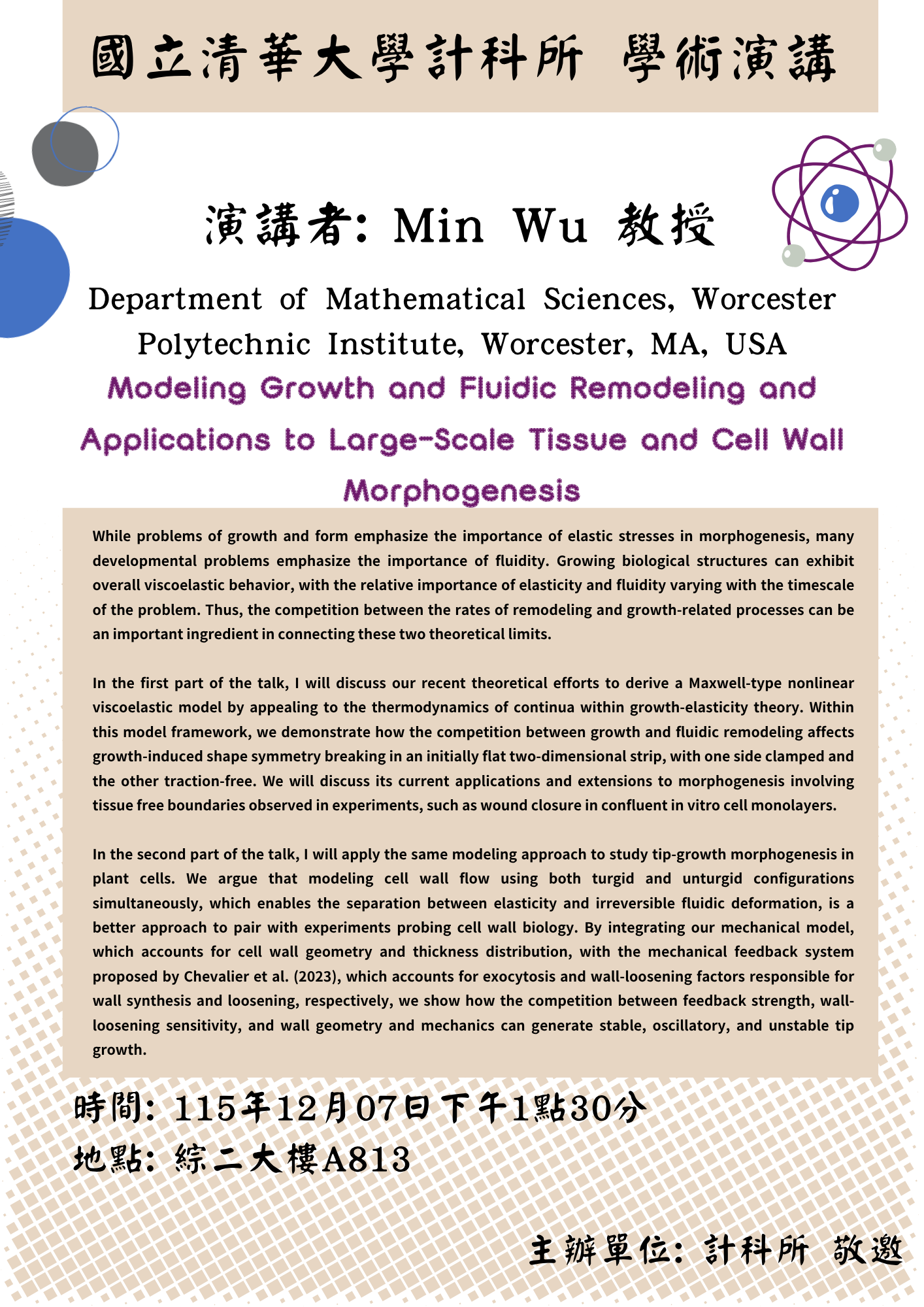
【講題】Modeling Growth and Fluidic Remodeling and Applications to Large-Scale Tissue and Cell Wall Morphogenesis
【演講時間】12月07日(星期一)下午1點30分
【演講地點】清華大學校本部第二綜合大樓B側8樓A813室
【摘要】
While problems of growth and form emphasize the importance of elastic stresses in morphogenesis, many developmental problems emphasize the importance of fluidity. Growing biological structures can exhibit overall viscoelastic behavior, with the relative importance of elasticity and fluidity varying with the timescale of the problem. Thus, the competition between the rates of remodeling and growth-related processes can be an important ingredient in connecting these two theoretical limits.
In the first part of the talk, I will discuss our recent theoretical efforts to derive a Maxwell-type nonlinear viscoelastic model by appealing to the thermodynamics of continua within growth-elasticity theory. Within this model framework, we demonstrate how the competition between growth and fluidic remodeling affects growth-induced shape symmetry breaking in an initially flat two-dimensional strip, with one side clamped and the other traction-free. We will discuss its current applications and extensions to morphogenesis involving tissue free boundaries observed in experiments, such as wound closure in confluent in vitro cell monolayers.
In the second part of the talk, I will apply the same modeling approach to study tip-growth morphogenesis in plant cells. We argue that modeling cell wall flow using both turgid and unturgid configurations simultaneously, which enables the separation between elasticity and irreversible fluidic deformation, is a better approach to pair with experiments probing cell wall biology. By integrating our mechanical model, which accounts for cell wall geometry and thickness distribution, with the mechanical feedback system proposed by Chevalier et al. (2023), which accounts for exocytosis and wall-loosening factors responsible for wall synthesis and loosening, respectively, we show how the competition between feedback strength, wall-loosening sensitivity, and wall geometry and mechanics can generate stable, oscillatory, and unstable tip growth.